Hydraulic Patient Transfer Stretcher for Elderly and Reduced-Mobility Care
Product Overview
Hydraulic Patient Transfer Stretcher for Reduced-Mobility Care
Patients with significantly reduced mobility often need more assistance when moving between a care bed, treatment area and rehabilitation space. For caregivers, the challenge is not simply moving the patient from one location to another. The transport surface must also provide suitable working height, patient positioning, lateral access and controlled maneuverability throughout the transfer process.
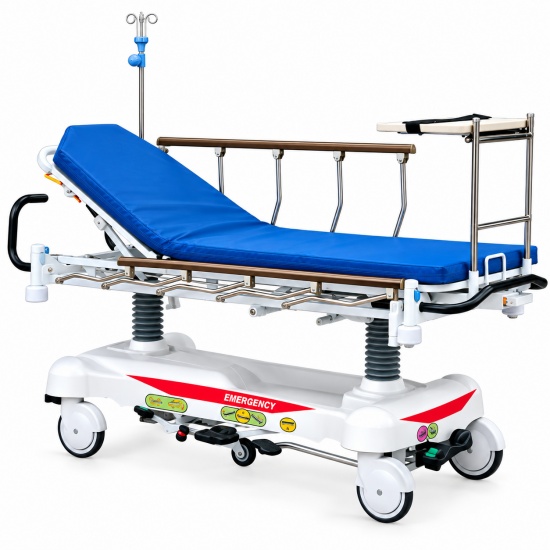
The JH-PC101 hydraulic patient transfer stretcher is designed for professional care environments where patients require a high level of transfer assistance. It combines 630–930 mm hydraulic height adjustment, a 320 kg safe working load, multi-position patient support, central braking and a retractable fifth wheel within one mobile platform.
Its X-ray translucent HPL platform, stainless steel folding side rails, large 200 mm medical casters, oxygen cylinder tray and IV pole further expand the stretcher's functionality for rehabilitation and professional long-term care applications.
630–930 mm Hydraulic Height Adjustment for Assisted Transfer
Match the Platform to Different Care Surfaces
The patient platform can be adjusted between approximately 630 mm and 930 mm using a dual hydraulic cylinder system.
This is particularly useful when caregivers need to position the stretcher alongside nursing beds or other patient-support equipment with different working heights.
Instead of requiring every transfer to take place at one fixed level, the platform can be raised or lowered according to the surrounding equipment and patient handling situation.
A More Adaptable Working Height for Caregivers
Patients with limited mobility may require substantial physical assistance during repositioning and transfer. Adjustable platform height gives caregivers greater flexibility to select an appropriate working level before patient handling begins.
320 kg Safe Working Load for a Wider Range of Patient Needs
High-Capacity Patient Support
The JH-PC101 has a specified safe working load of 320 kg.
For rehabilitation centers and professional care facilities, this provides a clearly defined load specification when selecting transfer equipment for different patient groups.
Safe working load should be considered together with the stretcher's dimensions, adjustment range and intended patient population when planning equipment for a care facility.
Multiple Patient Positions on One Transfer Platform
0–85° Backrest Adjustment
The backrest uses a gas-spring assisted system and can be adjusted from 0° to approximately 85°.
This allows caregivers to change the patient's upper-body position from flat lying to a substantially raised posture according to the transfer or temporary care requirement.
0–40° Knee Section Adjustment
The knee section can be adjusted between 0° and approximately 40° using the supplied manual crank.
This provides an additional positioning option for patients who need to remain on the stretcher before or after transportation.
0–18° Tilt Adjustment
The patient platform also provides approximately 0–18° of tilt adjustment, further expanding the available positioning configurations.
Together, height, backrest, knee and tilt adjustment allow the JH-PC101 to support different patient positions without functioning only as a fixed flat transport trolley.
Folding Side Rails Provide Protection without Blocking Caregiver Access
Stainless Steel Side Protection
The stretcher is equipped with stainless steel folding side rails measuring approximately 1240 mm in length.
When raised, the rails extend approximately 430 mm above the patient platform, providing lateral protection during transportation.
Reinforced Safety Locking Structure
The rail locking points use zinc die-cast components designed to provide a strong locking structure during routine operation.
Fold Down the Rails for Assisted Transfer
When caregivers need closer lateral access to a mobility-limited patient, the side rails can be folded down.
This is particularly practical during assisted transfer because staff can approach the patient more directly rather than working around a permanently raised side barrier.
Retractable Fifth Wheel for More Controlled Patient Transportation
Directional Guidance along Longer Routes
An independent retractable fifth wheel is positioned at the center of the stretcher chassis. Control pedals are provided on both sides for caregiver operation.
When engaged, the fifth wheel helps control the forward direction of the stretcher during transportation. This can be useful when moving a patient through longer corridors within a rehabilitation or care facility.
Free Caster Movement When More Maneuverability Is Required
When the fifth wheel is retracted, the stretcher returns to free caster movement for turning and positioning.
Caregivers can therefore select the mobility mode according to the route rather than relying on one wheel configuration for every transfer situation.
200 mm Casters with Central Braking System
Designed for Frequent Movement between Care Areas
Four 200 mm central-locking medical casters support routine movement through professional care environments.
The central braking system allows the four casters to be secured together through the foot-operated control system, eliminating the need to operate four individual caster brakes separately.
From Moving to Stationary Patient Care
Once the stretcher reaches the required location, caregivers can engage the central brake before beginning patient transfer, repositioning or other care procedures.
The central brake linkage uses an integrated round-tube structure for additional structural strength during repeated operation.
Four-Corner Bumper Wheels for Daily Facility Movement
The stretcher incorporates four 70 × 80 mm bumper wheels around its corners.
These components provide additional perimeter protection when the stretcher is maneuvered through doorways, corridors and other care areas where equipment may come into contact with surrounding structures.
X-Ray Translucent HPL Patient Platform
High-Strength 1926 × 620 × 6 mm Support Surface
The patient platform is manufactured from HPL material and measures approximately 1926 × 620 × 6 mm.
The platform provides a strong and dimensionally stable patient support surface while allowing X-ray transmission through the material.
This adds clinical flexibility when the stretcher is used in healthcare environments where diagnostic imaging access may form part of the patient's care process.
Integrated Oxygen Cylinder Tray
Keep Respiratory Support Equipment with the Patient
An integrated tray beneath the patient platform provides a dedicated location for carrying an oxygen cylinder during transportation.
The lower tray has a specified load capacity of 20 kg.
For patients requiring oxygen support, this allows compatible equipment to travel together with the stretcher rather than being managed entirely as separate transport equipment.
IV Pole Support for Continued Care during Transfer
The standard configuration includes one IV pole and four standard IV pole sockets.
An integrated storage holder is also provided for the IV pole when it is not being used.
This configuration is useful when a patient needs to continue infusion support while moving between different care areas.
Water-Resistant Mattress with Removable Cover
The stretcher includes a mattress measuring approximately 1840 × 600 × 80 mm.
The mattress fabric has a water-resistant surface treatment and a zippered outer cover that can be removed for washing.
For shared patient transfer equipment, accessible routine cleaning is an important practical consideration between uses.
How Can the JH-PC101 Support a Reduced-Mobility Transfer Workflow?
Step 1: Prepare the Stretcher
The stretcher can be positioned beside the patient's nursing bed or other support surface. Caregivers can adjust the hydraulic platform height and engage the central brake before beginning the transfer.
Step 2: Create Lateral Access
The stainless steel side rail can be folded down to give caregivers closer access to the patient during assisted movement onto the stretcher.
Step 3: Prepare for Transportation
Once the patient is correctly positioned, the side rail can be returned to its protective position. The patient's backrest, knee section and platform position can then be adjusted according to the care requirement.
Step 4: Select the Appropriate Mobility Mode
The fifth wheel can be engaged for greater directional control during longer straight routes or retracted when more flexible maneuvering is required.
Step 5: Secure the Stretcher at the Destination
After reaching the treatment or rehabilitation area, the central braking system can secure the four main casters before the next stage of patient handling begins.
Key Technical Specifications
Model: JH-PC101.
Product Type: Hydraulic Patient Transfer Stretcher.
Overall Size: 2140 × 910 × 630–930 mm.
Width with Side Rails Raised: 880 mm.
Patient Platform Size: 1926 × 620 × 6 mm.
Height Adjustment: 630–930 mm.
Height Adjustment System: Dual hydraulic cylinders.
Backrest Adjustment: 0–85°.
Backrest System: Gas-spring assisted.
Knee Section Adjustment: 0–40°.
Knee Adjustment: Manual crank.
Tilt Adjustment: 0–18°.
Safe Working Load (SWL): 320 kg.
Patient Platform: X-ray translucent HPL.
Frame: High-strength steel construction.
Side Rails: Stainless steel folding side rails.
Side Rail Length: 1240 mm.
Side Rail Height Above Platform: 430 mm.
Casters: 4 × Ø200 mm central-locking medical casters.
Brake System: Central braking system.
Directional System: Retractable central fifth wheel.
Corner Protection: 4 × 70 × 80 mm bumper wheels.
Lower Storage: Integrated oxygen cylinder tray, 20 kg load capacity.
IV Pole: 1 pc.
IV Pole Sockets: 4 standard sockets.
Mattress Size: 1840 × 600 × 80 mm.
Mattress Cover: Water-resistant, zippered and removable for washing.
Optional Accessory: Patient record table / chart table.
For Rehabilitation and Professional Long-Term Care Projects
The JH-PC101 is suitable for professional care environments where patients with reduced mobility require substantial assistance during transportation and repositioning.
Its 320 kg safe working load, hydraulic height adjustment, multi-position patient platform, folding side access and controlled mobility system make it a practical option for rehabilitation centers and long-term care projects requiring a higher-specification transfer stretcher.
Explore our Patient Transfer Equipment range for additional patient handling and transport solutions.
For facilities planning both patient transfer and long-term accommodation, explore our Nursing Bed range for additional elderly and reduced-mobility care equipment.
For technical specifications, available configurations, project quantities or OEM/ODM requirements, contact us with your purchasing requirements.
Frequently Asked Questions
Yes, we support comprehensive OEM and ODM customization services. We can adjust bed size, load-bearing capacity, number of adjustment functions, bed surface material, guardrail style and overall color according to your demands. For medical institutions, we can also add matching auxiliary accessories
We support door-to-door global shipping covering Europe, North America, Southeast Asia, Middle East and other regions. All medical beds are shipped with modular packaging to reduce transportation damage. We provide free detailed English paper installation manuals and step-by-step installation video
Our full range of medical beds supports multi-scenario use. Electric medical beds and manual hospital beds are specially designed for general wards, intensive care units and emergency rooms of public and private hospitals. Nursing beds with side rails and anti-fall functions are perfect for nursing
Related Products You May Like
Sliding Patient Transfer Troll...
Sliding Patient Transfer Trolley for Patients Requiring Assisted MovementPatient
Manual Patient Transport Troll...
Height Adjustable Patient Transfer Stretcher for Reduced-Mobility CarePatients w
Hydraulic Patient Transfer Str...
Hydraulic Patient Transfer Stretcher for Reduced-Mobility CarePatients with sign