Residential-Style Electric Standing Bed for Elderly Rehabilitation Care
Product Overview
Standing Rehabilitation Without Turning the Room into a Clinical Space
Rehabilitation equipment used in elderly care has to meet two very different requirements. It must provide the positioning and standing functions required by caregivers, while also fitting naturally into an environment where residents may live for months or years. This electric standing bed was developed around both needs.
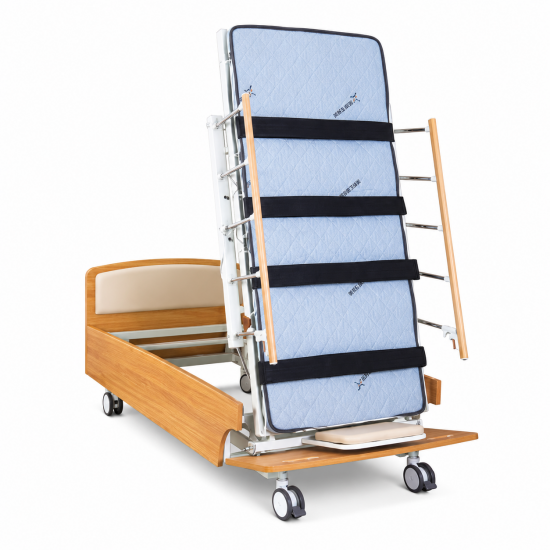
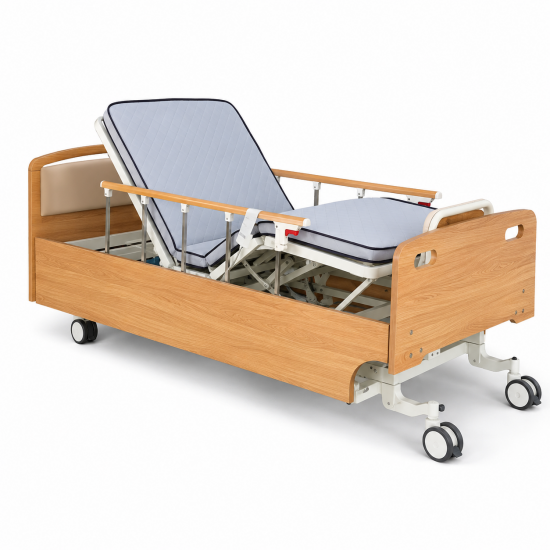
Instead of the exposed institutional appearance commonly associated with rehabilitation equipment, the bed uses a residential-style wood-finish surround with coordinated head and foot panels. Behind this warmer exterior is an electrically controlled rehabilitation platform capable of backrest adjustment, leg positioning and progressive tilt-up standing.
This combination makes the model particularly relevant for nursing homes, senior rehabilitation centers, assisted living facilities and long-term care projects where rehabilitation equipment forms part of the resident's everyday living space.
Designed Around the Needs of Elderly Rehabilitation
Progressive Tilt-Up Rather Than an Abrupt Position Change
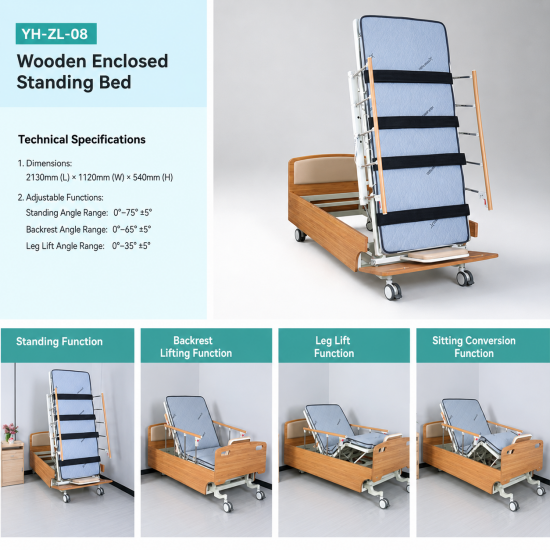
The complete support platform can be electrically tilted from 0° to 75° ±5°. This allows the user to be moved progressively from a horizontal position toward an upright position during supervised standing rehabilitation.
The adjustable angle gives rehabilitation professionals greater flexibility to select intermediate positions instead of moving directly from lying to a near-standing posture. For elderly users with limited mobility, this provides a practical platform for structured tilt-up and standing programs according to individual care plans.
Multi-Point Support During Standing Training
Several adjustable body support straps are arranged along the platform. They provide additional stabilization to the upper body and lower limbs as the standing angle increases.
This support arrangement is an important part of the bed's rehabilitation configuration and distinguishes the product from a conventional electric elderly care bed with only back and leg adjustment.
Useful Between Rehabilitation Sessions Too
A standing bed used in long-term care should remain useful when standing exercises are not being performed. For this reason, the model incorporates independent back and leg positioning functions that support routine activities throughout the day.
0°–65° ±5° Backrest Adjustment
The electrically operated back section can be raised to approximately 65° ±5°. It provides supported upper-body positioning for activities such as eating, reading, communication and routine bedside care.
0°–35° ±5° Leg Section Adjustment
The leg section can be electrically adjusted through a range of 0°–35° ±5°. It can be used independently or together with the back section to create different supported positions according to the resident's daily care requirements.
Supported Sitting Position
Combined adjustment of the back and leg sections allows the sleeping platform to transition toward a chair-style position. This gives caregivers an additional positioning option between flat lying and standing rehabilitation.
Facilities that do not require standing rehabilitation for every resident can combine this model with conventional Nursing Bed products to create different levels of care equipment within the same elderly care project.
A More Residential Approach to Rehabilitation Equipment
Wood-Finish Surround for Long-Term Living Environments
The visual character of a bed can be particularly important in elderly care. Residents in nursing homes and long-term care facilities are not simply receiving short-term treatment; the room often becomes part of their everyday living environment.
The wood-finish headboard, footboard and surrounding panels give this rehabilitation bed a warmer furniture-like appearance. This helps reduce the strong clinical impression associated with exposed medical equipment and allows the bed to coordinate more naturally with wooden bedside cabinets and other furniture commonly used in senior living rooms.
Function Hidden Within a Familiar Exterior
The residential appearance does not replace the rehabilitation structure. The electric mechanisms and adjustable platform remain integrated within the bed, allowing the product to retain its standing and positioning capabilities while presenting a more appropriate appearance for elderly care environments.
One Bed for Care and Rehabilitation Planning
For nursing home operators and elderly care project buyers, equipment planning often involves residents with different levels of mobility. Some require conventional electric positioning, while others may also participate in supervised standing rehabilitation.
This model fills the space between those requirements. It provides the everyday positioning expected from an adjustable care bed while adding the specialized tilt-up capability of a Standing Bed.
Product Dimensions and Adjustment Ranges
Technical Configuration
Overall Dimensions
2130 × 1120 × 540 mm.
Electric Standing / Tilt-Up Angle
0°–75° ±5°.
Electric Backrest Angle
0°–65° ±5°.
Electric Leg Adjustment Angle
0°–35° ±5°.
Standing Support System
Multiple adjustable support straps provide additional body stabilization during supervised tilt-up and standing procedures.
Exterior Configuration
Residential-style wood-finish headboard, footboard and surrounding panels designed for elderly and long-term care environments.
Where Does This Model Fit in an Elderly Care Facility?
This product is particularly suitable where a conventional nursing bed does not provide enough rehabilitation capability, but a strongly clinical standing platform would be visually unsuitable for the care environment.
Recommended Applications
Nursing Homes
Suitable for residents whose care programs combine electric bed positioning with supervised standing rehabilitation.
Senior Rehabilitation Facilities
The 75° tilt-up capability provides a dedicated rehabilitation function while the back and leg sections remain available for routine positioning between training sessions.
Long-Term Care Facilities
The residential exterior is especially relevant where the bed remains permanently inside a resident's room rather than being used only in a dedicated therapy department.
Assisted Living and Elderly Care Projects
The wood-finish design can be coordinated with other care furniture, helping project buyers create a more consistent room environment across different levels of resident care.
Choosing Between a Nursing Bed and a Standing Rehabilitation Bed
For buyers, the key question is whether the resident requires only everyday electric positioning or an additional progressive standing function. A conventional nursing bed may be sufficient when the main requirements are backrest, leg and height adjustment. When controlled tilt-up rehabilitation is part of the care program, a standing rehabilitation model provides a more specialized solution.
This product is therefore positioned as an elderly rehabilitation bed rather than simply a wooden nursing bed. Its defining feature is the combination of a 0°–75° electric standing range with everyday back and leg positioning inside a residential-style bed structure.
Explore our Standing Bed range for additional rehabilitation configurations, or contact us for specifications, project quantities, configuration requirements and OEM options.
Frequently Asked Questions
Yes, we support comprehensive OEM and ODM customization services. We can adjust bed size, load-bearing capacity, number of adjustment functions, bed surface material, guardrail style and overall color according to your demands. For medical institutions, we can also add matching auxiliary accessories
We support door-to-door global shipping covering Europe, North America, Southeast Asia, Middle East and other regions. All medical beds are shipped with modular packaging to reduce transportation damage. We provide free detailed English paper installation manuals and step-by-step installation video
Our full range of medical beds supports multi-scenario use. Electric medical beds and manual hospital beds are specially designed for general wards, intensive care units and emergency rooms of public and private hospitals. Nursing beds with side rails and anti-fall functions are perfect for nursing
Related Products You May Like
Electric Standing Rehabilitati...
Supporting Elderly Care from Bed Positioning to Upright RehabilitationOlder adul
Residential-Style Electric Sta...
Standing Rehabilitation Without Turning the Room into a Clinical Space Rehabi
Electric Standing Rehabilitati...
Electric Standing Rehabilitation Bed for Elderly Mobility and Daily CareThe Elec