Height Adjustable Patient Transfer Stretcher for Elderly and Reduced-Mobility Care
Product Overview
Patient Transfer Stretcher Designed for Elderly and Reduced-Mobility Care
Moving an elderly patient from one care area to another can become difficult when the patient has limited mobility or cannot reposition independently. In nursing homes, rehabilitation centers and long-term care facilities, caregivers need transfer equipment that can adapt to different patient positions while remaining easy to move and secure.
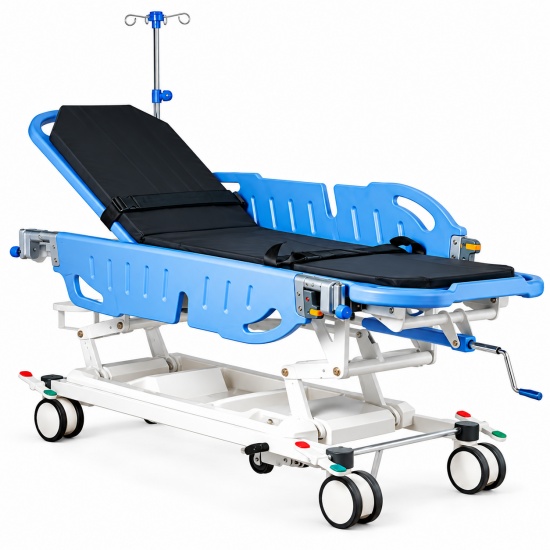
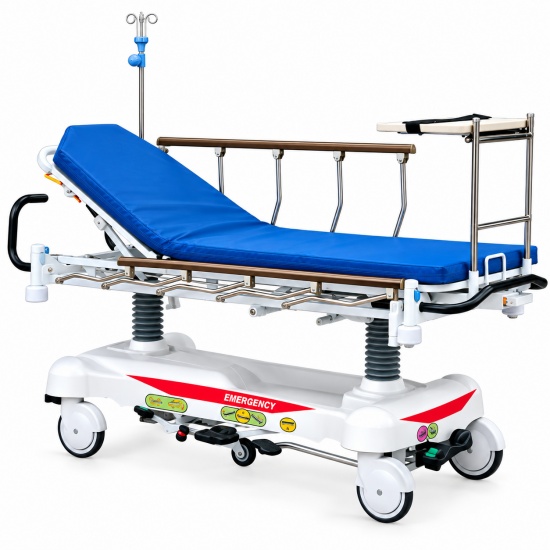
The JH-OCT102 height adjustable patient transfer stretcher is designed for this type of assisted movement. It combines a 510–850 mm adjustable patient platform, 0–70° gas-spring assisted backrest, central braking system, horizontally folding side rails and 150 mm twin-wheel medical casters.
These functions make the stretcher suitable for transporting elderly and mobility-limited patients between care rooms, rehabilitation areas, treatment spaces and other departments within professional care facilities.
Height Adjustment Helps Adapt to Different Transfer Situations
510–850 mm Adjustable Patient Platform
The stretcher provides a platform height range of approximately 510–850 mm. Caregivers can adjust the patient surface according to different transfer and care requirements instead of relying on a fixed-height trolley.
For elderly patients who require substantial physical assistance, appropriate platform height can be particularly useful when preparing for lateral transfer or positioning the stretcher alongside other patient-care equipment.
Useful in Long-Term Care Environments
Care facilities often use different types of nursing beds, examination equipment and rehabilitation devices. Their patient support surfaces may not all be positioned at the same height.
A height-adjustable transfer stretcher provides additional flexibility when caregivers need to move a resident between different care areas and equipment configurations.
0–70° Backrest Adjustment for Different Patient Positions
Gas-Spring Assisted Upper-Body Positioning
The backrest can be adjusted from 0° to approximately 70° using a gas-spring assisted mechanism. This allows the upper-body position to be changed without an electric backrest actuator.
Patients can therefore remain in a flat lying position during transportation or be repositioned into a more upright posture when required for temporary resting or care.
More Flexible than a Fixed Flat Transport Trolley
Some elderly patients may need to remain on the stretcher for a period before or after transportation. An adjustable backrest gives caregivers greater flexibility to modify the patient's position without immediately transferring the patient to another support surface.
Folding Side Rails Provide Protection and Easier Transfer Access
Lateral Protection during Patient Movement
Protective side rails provide lateral support while the patient is positioned on the stretcher. This is especially relevant for elderly or mobility-limited patients who may have difficulty maintaining their position independently during movement.
Horizontal Folding Design Opens the Side of the Stretcher
When caregivers need closer access to the patient, the side rails can be lowered horizontally. Opening the side of the patient platform provides more convenient access during transfer, examination, infusion procedures and other assisted-care tasks.
The side rail system incorporates a safety locking mechanism to secure the protective components in their working position.
Central Braking System for Frequent Stop-and-Go Transfer
Convenient Foot-Operated Brake Control
The stretcher is equipped with a central braking system operated through foot controls positioned around the chassis.
This allows caregivers to secure the stretcher after it reaches the required location without individually operating each caster brake, which is useful when the equipment is moved frequently throughout a care facility.
From Transportation to Stationary Care
A transfer stretcher often alternates repeatedly between movement and stationary positioning. The central braking system provides a practical way to manage these transitions during routine elderly care.
150 mm Twin-Wheel Casters for Facility Mobility
Designed for Indoor Patient Transportation
Four 150 mm twin-wheel resin casters support movement through corridors and different care areas. The caster configuration works together with the central braking system to provide mobility during transport and secure positioning when the stretcher is stationary.
This mobile design is suitable for facilities where residents need to be moved regularly between nursing, treatment and rehabilitation areas.
Molded PP Components for Practical Daily Care
Smooth Patient Platform and Protective Surfaces
The patient platform and protective components use molded PP construction. The smooth molded surfaces provide a practical configuration for routine cleaning and everyday use in professional elderly care environments.
The PP components are integrated into the stretcher structure to provide patient support while maintaining a clean medical appearance.
Integrated IV Pole for Continued Care during Transfer
An IV pole is included with the stretcher, allowing infusion support to remain available when required during patient transportation.
This can be useful for residents or rehabilitation patients who need to move between different departments without unnecessarily interrupting an ongoing infusion procedure.
How Does This Stretcher Support Reduced-Mobility Patients?
It Adapts to the Transfer Environment
The 510–850 mm height range allows caregivers to reposition the stretcher according to different care equipment and transfer situations.
It Adapts to the Patient's Upper-Body Position
The 0–70° gas-spring assisted backrest allows the patient to remain flat or move into a more upright position according to the care requirement.
It Opens for Closer Caregiver Access
Horizontally folding side rails allow the side of the stretcher to be opened when caregivers need closer access for assisted transfer or other care procedures.
It Can Be Secured after Reaching the Destination
The central braking system allows caregivers to switch from mobile transport to stationary positioning through conveniently located foot controls.
Suitable for Elderly Care and Rehabilitation Facilities
The JH-OCT102 can be used in elderly care facilities, rehabilitation centers, nursing institutions and other professional care environments requiring routine transportation of patients with reduced mobility.
Rather than functioning only as a basic transport trolley, the combination of adjustable height, adjustable backrest, folding side access and central braking allows the stretcher to support different stages of assisted patient movement.
Key Technical Specifications
Model: JH-OCT102.
Product Type: Height Adjustable Patient Transfer Stretcher.
Overall Size: 1925 × 663 × 510/850 mm.
Height Adjustment: 510–850 mm.
Backrest Adjustment: 0–70°.
Backrest Mechanism: Gas-spring assisted adjustment.
Patient Platform: Molded PP construction.
Side Rails: Horizontally folding side rails.
Side Rail Safety: Safety locking mechanism.
Caster Diameter: 150 mm.
Caster Type: Twin-wheel resin medical casters.
Brake System: Central braking system with foot controls.
Rated Load Capacity: 300 kg.
IV Pole: Included.
Patient Transfer Equipment for Long-Term Care Projects
For elderly care and rehabilitation projects, patient transfer equipment should be selected together with the beds and other support equipment used throughout the facility. Platform height, patient positioning, side access and mobility all affect how caregivers move residents between different care environments.
Explore our Patient Transfer Equipment range for additional transport solutions and our Nursing Bed range for long-term elderly and mobility-limited patient care.
For technical specifications, available configurations, purchasing quantities or OEM/ODM requirements, contact us with your project requirements.
Frequently Asked Questions
Yes, we support comprehensive OEM and ODM customization services. We can adjust bed size, load-bearing capacity, number of adjustment functions, bed surface material, guardrail style and overall color according to your demands. For medical institutions, we can also add matching auxiliary accessories
We support door-to-door global shipping covering Europe, North America, Southeast Asia, Middle East and other regions. All medical beds are shipped with modular packaging to reduce transportation damage. We provide free detailed English paper installation manuals and step-by-step installation video
Our full range of medical beds supports multi-scenario use. Electric medical beds and manual hospital beds are specially designed for general wards, intensive care units and emergency rooms of public and private hospitals. Nursing beds with side rails and anti-fall functions are perfect for nursing
Related Products You May Like
Hydraulic Patient Transfer Str...
Hydraulic Patient Transfer Stretcher for Reduced-Mobility CarePatients with sign
Height Adjustable Patient Tran...
Patient Transfer Stretcher Designed for Elderly and Reduced-Mobility CareMoving